SETSPACE
A studio-booking marketplace where Postgres itself refuses double bookings. A personal build.
DevelopmentUI Design
- Role
- Design & full-stack development
- Type
- Personal project
- Stack
- Next.js 15, Payload CMS 3, Postgres 17, Stripe
- Timeline
- 2026
Summary
SETSPACE is a personal project, not a real company. I built it to show what I can do with the tools behind it: a marketplace for booking photo, film and podcast studios in Toronto, Montréal, Vancouver and Calgary. I researched the references, set the design system and designed every screen in Figma, then built it with Next.js, Payload CMS, Postgres and Stripe in test mode. Every studio, account, price and booking in it is demo data.
Live site
The real site, running on a server with its own Postgres database. Sign in as the guest or host in one click, book a studio, then try to book the same slot again. Every account, studio and booking is demo data, and checkout takes test cards only.
setspace.samuelrolandvroom.comDesign prototype
The connected Figma prototype from the design stage, before the site moved to Canadian cities and prices. Click through search, a studio, checkout, the guest account and the host dashboard.
Open full screenScreens
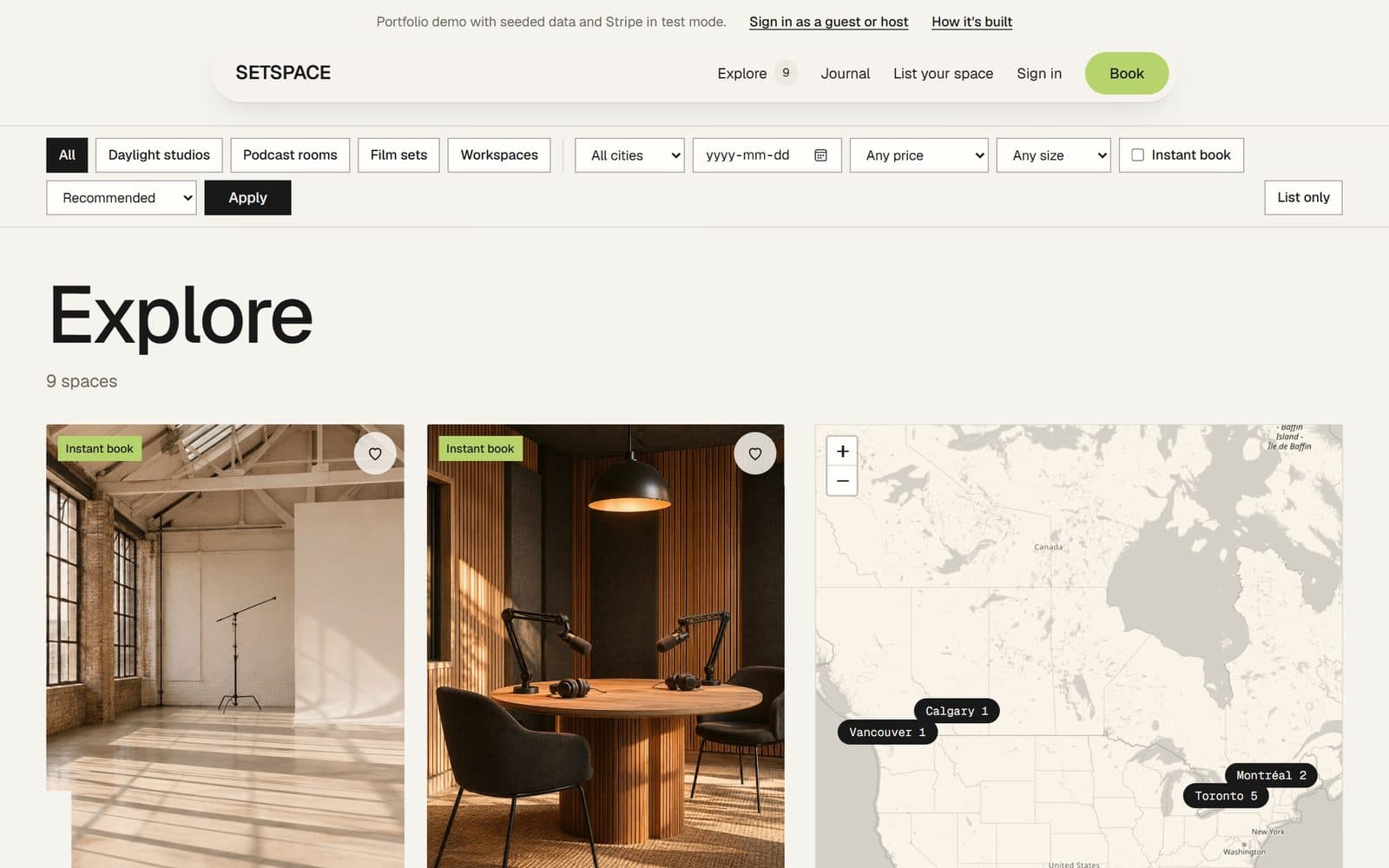
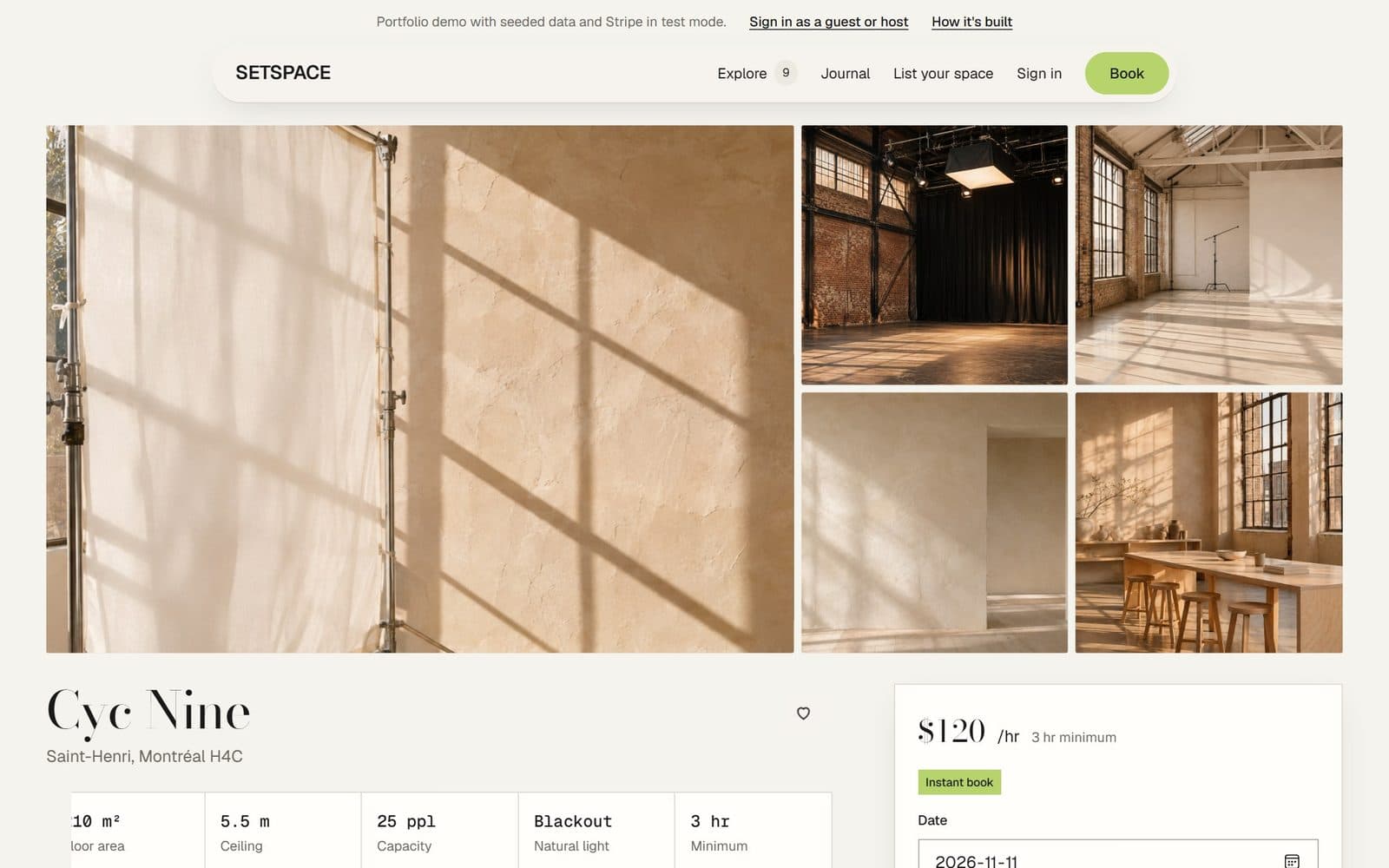
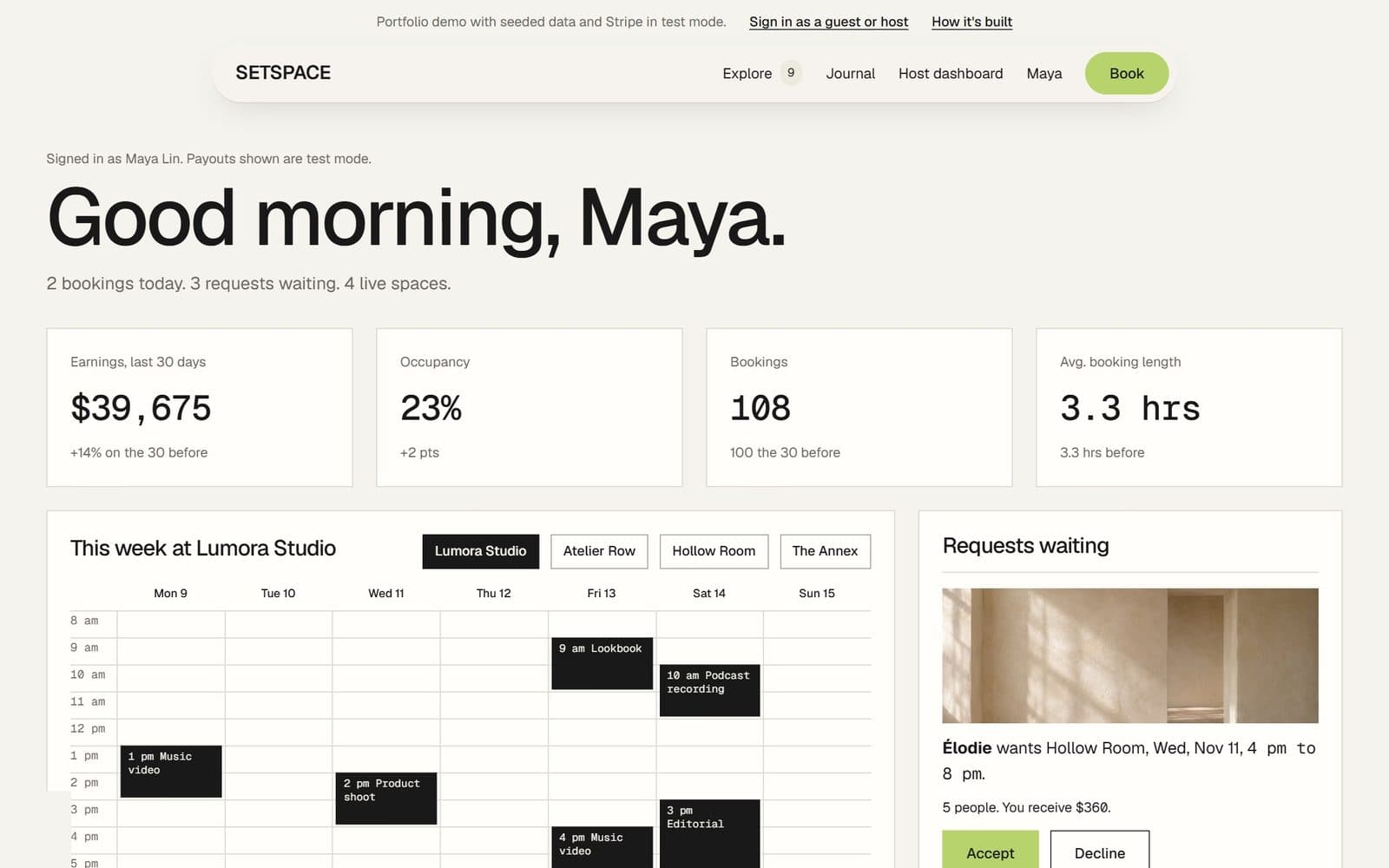
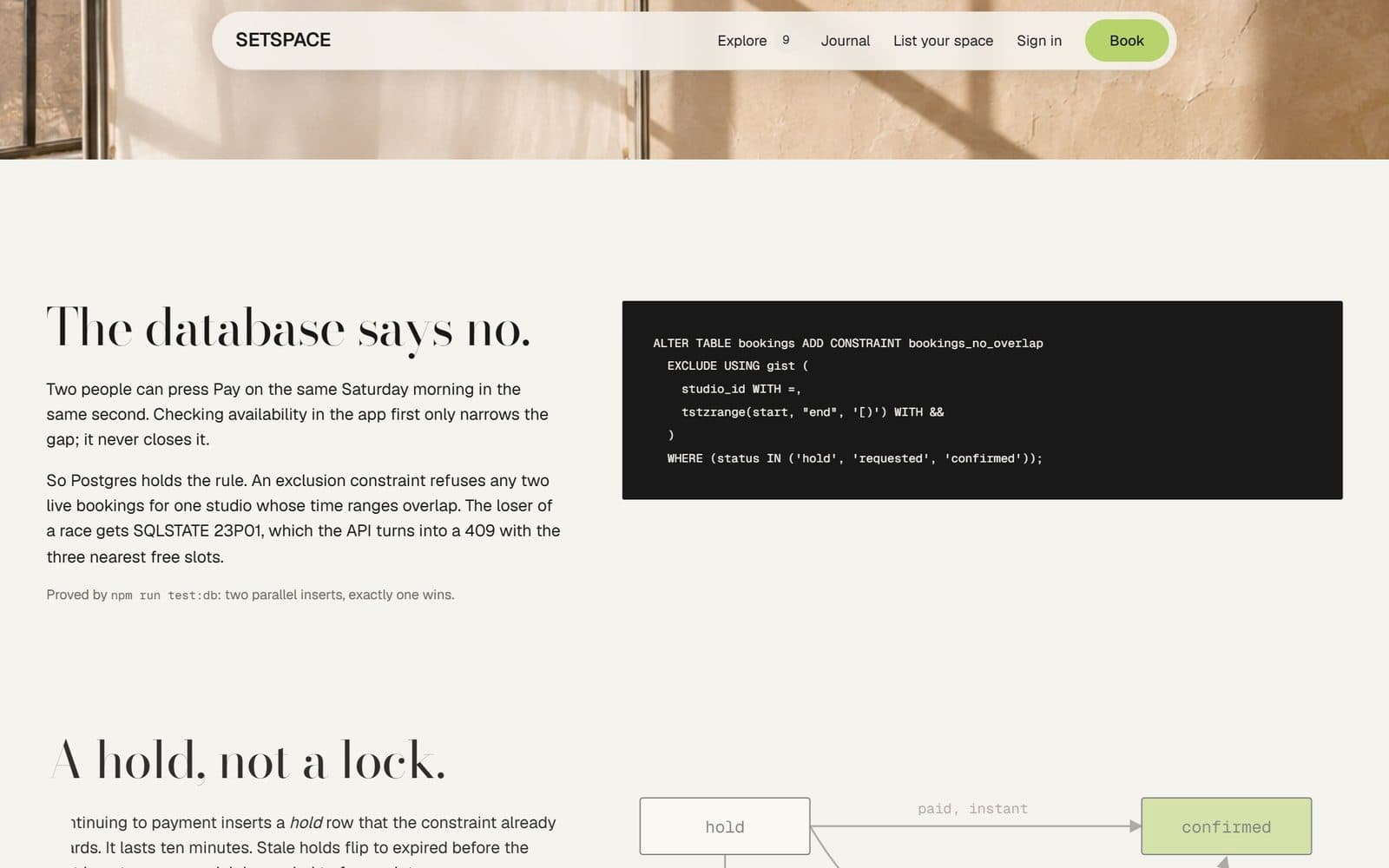
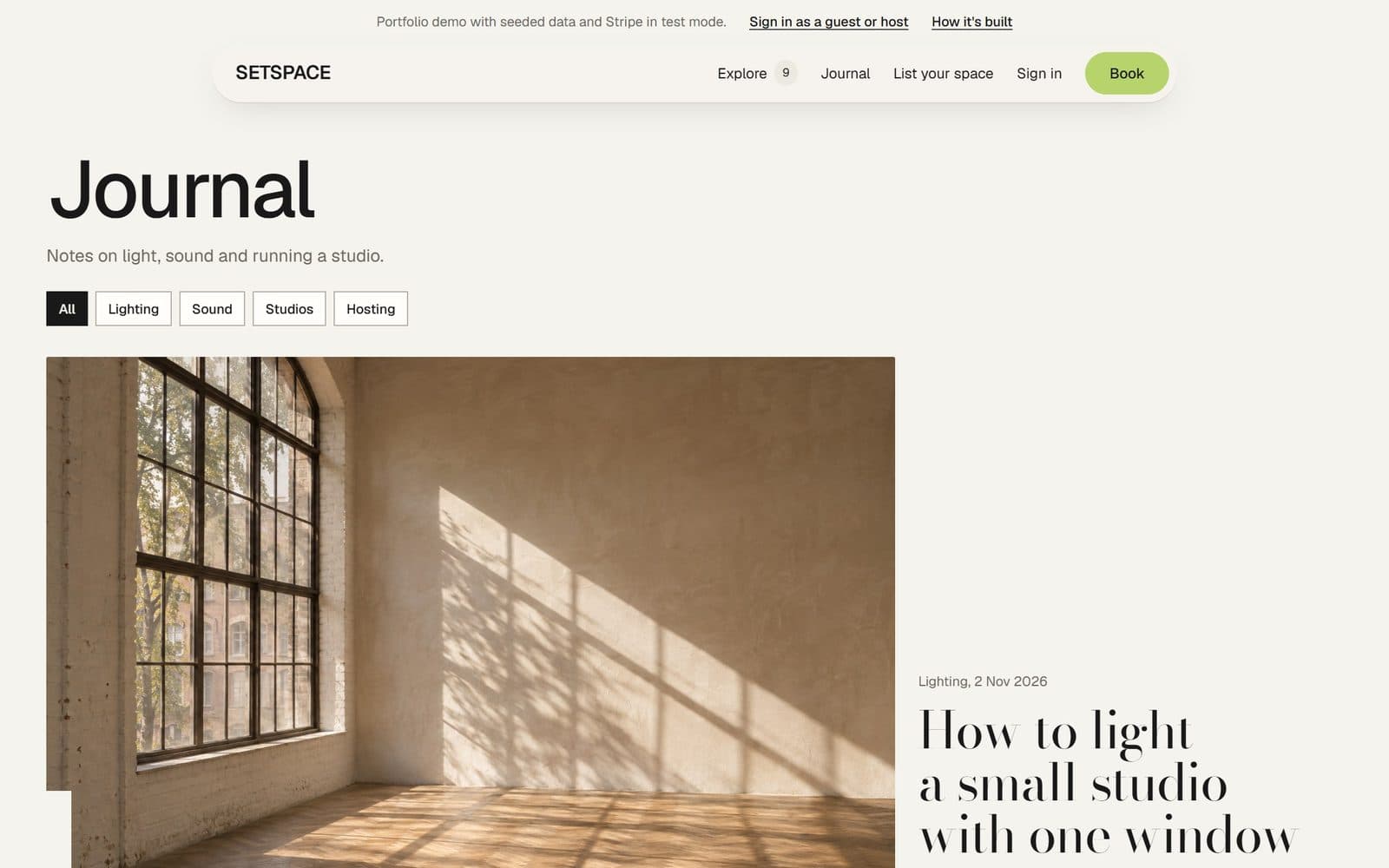
Screenshots of the running site. Every name and number in them is demo data.
Research & design
I started by taking apart Peerspace, Giggster, Airbnb's total-price display and Calendly's time-zone handling, then wrote the design system: paper, ink and a single lime signal colour, Geist for the product and Bodoni Moda for names and prices. I built 19 editable screens in Figma (desktop, mobile and dark mode) with colour variables, type styles, component variants and a connected prototype, plus a small Figma plugin that imports the whole package.
One room, one booking
Two people can press Pay on the same slot in the same second, and checking availability in the app only narrows that gap. So the database holds the rule: a Postgres exclusion constraint refuses any two live bookings for one studio whose time ranges overlap. The API turns the refusal into a 409 with the three nearest free slots, and a test fires two parallel inserts to prove exactly one wins. Continuing to payment places a ten-minute hold that the same constraint guards, so no cron job is needed to free a slot.
Checking first only narrows the race. The database has to say no.
Time zones, tax & payments
Each studio stores its own IANA time zone and every booking is a UTC instant, with unit tests for spring-forward and fall-back days in Toronto, Calgary and Vancouver. Checkout adds the province's sales tax on the booking and service fee: HST in Ontario, GST and QST in Québec, GST in BC and Alberta. Stripe runs in test mode; instant studios charge on confirm, request-to-book studios authorise and capture only when the host accepts, and cancellations refund by the studio's tier.
Who can see what
Booking numbers run in order, so a guest's link carries a random token, and without it or the right session the page is a 404. Payload's access rules keep bookings readable only by their guest, the studio's host or an admin, never writable over REST, and sign-up can't grant itself a role. Guest, host and admin each have their own views, including a host dashboard with schedule, requests and analytics.